Out of the Wilderness
It is only fitting that the Catholic Church in Tennessee was also born in the wilderness through the tireless work of horseback missionaries, visiting widely scattered Catholic communities. The road to the Diocese of Nashville is filled with the labors of many—far more than this account could share—from a scattered few on the western frontier to the vibrant and diverse community that worships, gathers, and serves Middle Tennessee today. But this story does not begin in Tennessee. It begins in Spain.
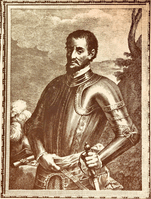
Christopher Columbus may not have made it to India, but in the years after he crossed the Atlantic Ocean, the Spanish set their sights on the New World, which offered untold wealth and opportunity to expand their kingdom, their people, and their Catholic faith. For many Spanish explorers, a trip to the New World was a death sentence. Some died in battle, others from hunger and disease. Hernando de Soto would eventually fall to disease as well, but he came more prepared than his predecessors with horses to master the terrain, pigs to abate their hunger when the land offered little, and at least eight priests to nurture their souls and minister to the natives. The expedition of roughly 700 people made its way north through present-day Florida and the Carolinas, eventually crossing a gap in the Appalachian Mountains near Etowah, Tennessee, in 1540.
The party soon happened across a settlement along the Tennessee River at Moccasin Bend in present-day Chattanooga. Camped below Lookout Mountain in the crook of the river, the priests among the party would have almost certainly celebrated Mass. Judging from accounts of the journey the Masses may not have included the full celebration of the Eucharist, though, because the priests would not have had access to the proper bread and wine to be consecrated at Mass. Some speculate this was the first time that Mass was celebrated in Tennessee—and if it did not happen on Moccasin Bend, it certainly did at one of the many sites where the expedition stopped in the territory before continuing westward to the Mississippi River. The faith failed to take hold in the wake of these explorers, and by the time the British arrived, the only remnant of the Spanish Catholics’ voyage across the southern part of the continent was a small community in St. Augustine, Florida.
The next European Catholics to reach Tennessee were French fur trappers known as coureur des bois. These “runners of the woods” traveled south from the St. Lawrence River and the Great Lakes and established settlements along the Mississippi River. The French army followed, eager to establish their territory. Jean-Baptiste Le Moyne established a fort on the bluffs near the railroad bridges in present-day Memphis. The structure was completed on August 15, 1739, the Feast of the Assumption of the Blessed Virgin Mary, and was appropriately named Fort Assumption. Their occupation lasted only a few months.
In the true spirit of the faith, it would take a community to establish what the army could not. In the late 1760s, a coureurs de bois from Quebec named Jacques-Timothée Demonbreun began trapping fur in Western Kentucky and Middle Tennessee. The territory was remote and wild, a true frontier. In the hills near modern-day Nashville, Demonbreun, who was a devout Catholic, found abundant game to trap, thanks to the presence of a great salt lick, the by-product of sulfur springs to the north. He slept in a cave above the Cumberland River, and though he would not make Nashville his permanent home until 1790, Demonbreun is often referred to as Tennessee’s “first citizen.”
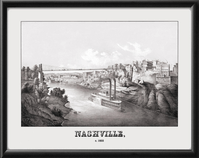
Others soon made their way to the area, drawn by the same opportunities as Demonbreun. On Christmas Day 1779, James Robertson established Fort Nashborough, near the salt lick. John Donelson soon reinforced Robertson with a large party of settlers from North Carolina, and the thriving settlement was renamed Nashville in 1784. Demonbreun returned six years later and opened a store and tavern on what is now 3rd Avenue North. There was now a permanent Catholic presence in the Tennessee frontier. All they needed was a priest.
Before he was the first bishop of Bardstown, Benedict Joseph Flaget traveled from Bordeaux, France, in 1792 to the New World. Like other Sulpicians who were fleeing the martyrdom that their confreres met in the bloody French Revolution, he came to Baltimore at the invitation of Bishop John Carroll to serve the emerging Catholic Church in America. Most of the original thirteen states’ Catholics were in Maryland, but soon the growing desire for westward expansion led several Catholic families to head west into Kentucky. Bishop Carroll, the new nation’s first bishop, sent Flaget into the Ohio River Valley in service to these families and the many French settlers who had remained there. These were difficult times, but it was this missionary work that laid the groundwork for the subdivision of the Diocese of Baltimore with the establishment of the dioceses of Bardstown, as well as New York, Boston, and Philadelphia in 1808. The priests traveled rough, a horse their most valuable possession. With just $200 per year in pay, priests like Father Flaget wore shabby clothes, often the same as their parishioners, and in kind, were humbly addressed as “Mister,” not “Father.” In Flaget’s company since France was a man named Stephen Theodore Badin, a deacon who would later be ordained by Carroll—the first priest ordained in the United States. Father Badin’s early assignment brought him into the unknown as the first missionary to the territory that included Tennessee. He traveled the region extensively, preaching publicly and bringing the sacraments to many Catholics in their new homestead. Eventually, Badin and Flaget had a parting of ways, and Badin spent time in France before returning to the Midwestern United States where he helped establish the University of Notre Dame. Again, Tennessee Catholics were on their own.